




Roof deck waterproofing failures rarely announce themselves with a single dramatic flood. The process starts as a small stain on the ceiling below, a damp patch in a concrete column, or a slow darkening around a drain fitting. By the time water shows up inside the building, it has typically been tracking through the substrate for months, saturating insulation, softening timber framing, and initiating the rebar corrosion that costs ten times more to fix than the original membrane failure. The repair bill for a failed deck membrane is manageable. The bill for the structural remediation underneath it is not.
This guide covers everything you need to make sound decisions about your roof deck or terrace waterproofing: the systems available, how they perform over time, what they cost installed, how a quality job is built from the ground up, and what distinguishes a durable result from one that fails in five years. High annual rainfall, strong UV exposure, and thermal cycling put deck membrane systems under sustained pressure year-round. At CCR Waterproofing, we work on these projects regularly, and the patterns of what works and what fails are consistent. This article is the practical guide we wish more property owners had before the first leak appeared.
Why roof deck waterproofing fails and what it costs when it does
The structural consequences of water ingress on a rooftop deck
Water that penetrates a roof deck surface does not stay put. It follows the path of least resistance through the substrate, into insulation layers, and down to the structural elements beneath. On a concrete deck, this means moisture reaching the reinforcing steel, triggering corrosion, expanding the rebar, and cracking the concrete from the inside out. On a timber-framed structure, it means rot that can compromise the entire floor assembly. The moment structural remediation enters the picture, costs escalate sharply. A membrane replacement on an otherwise sound deck is a contained cost. The same replacement, combined with crack injection, rebar treatment, and concrete spall repair, becomes a significantly larger project.
Ponding water compounds the problem. Standing water on a deck surface dramatically accelerates membrane degradation, softens adhesive bonds, and increases hydrostatic pressure at every joint and termination. A deck that drains well gives the membrane a fighting chance. One that ponds regularly does not.
What makes rooftop decks uniquely vulnerable compared to standard roofs
A standard low-slope roof carries one primary load: weather. A rooftop deck carries weather plus foot traffic, furniture loads, point loads from balustrade posts and planters, UV exposure on a surface that must also be walkable, and the constant thermal movement of a surface exposed to full sun. Every post anchor, drain fitting, and balustrade fixing is a potential penetration through the waterproofing plane. Each one demands precise detailing, and none of them are forgiving of shortcuts. This combination of competing demands is why system selection and installation quality matter far more on a rooftop deck than on a standard concealed roof membrane.
The four main deck waterproofing systems compared
Liquid-applied membranes: seamless coverage for complex geometry
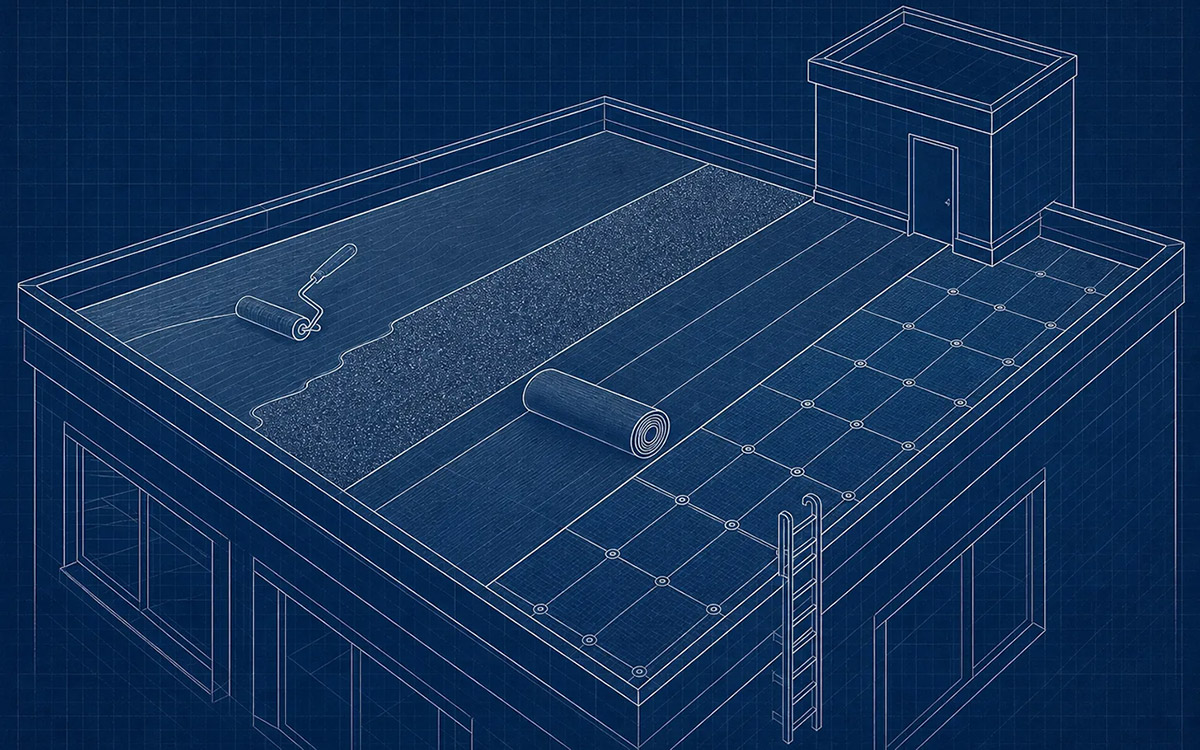
Liquid-applied membranes cure into a single continuous layer with no seams, which makes them the strongest choice for decks with multiple penetrations, irregular shapes, and tight corners at walls or parapets. The system is applied wet, embeds a reinforcing fabric in the base coat, then receives one or more finish coats to the specified dry-film thickness. When installed correctly, a quality liquid membrane system delivers 10 to 20 years of service life, with some cold-applied systems reaching 20 to 30 years under good maintenance conditions. Thickness consistency is the critical variable. A liquid membrane applied too thinly will underperform regardless of the product quality, which is why skilled application is non-negotiable. These systems are also among the most retrofit-friendly options available: recoating is straightforward when the existing surface is sound, making mid-life maintenance cost-effective. Liquid-applied acrylic membranes with reinforcing fabric are among the most commonly specified roof deck waterproofing systems, and for good reason.
Sheet membranes (EPDM, TPO, PVC): factory-controlled thickness and proven longevity
Sheet membrane systems arrive on site with a factory-controlled thickness, which removes one of the key application variables that affects liquid systems. EPDM, TPO, and PVC membranes have long track records on low-slope roofs and are increasingly common on rooftop decks. A quality installation delivers 15- to 25-plus years of service life. The trade-off is that seams and laps become the critical weak points. Heat-welded or chemically bonded seams require precise execution, and detailing around penetrations and corners demands more care than the open field of the membrane. The quality of seam workmanship determines whether a sheet membrane system meets its rated service life or fails well short of it. Substrate preparation is equally critical: a sheet membrane bonded to a compromised substrate will debond and lift, creating water-entry points at the laps.
Modified bitumen and vinyl deck systems: when to consider each
Modified bitumen is a well-established option for contractors experienced in torch-applied or self-adhered assemblies. It offers good traffic resistance and a service life of roughly 15 to 20 years. Torch-on multi-ply systems deliver robust protection, though the application method adds complexity and the seam-detailing discipline required is the same as any sheet system. Vinyl deck systems function as a combined waterproofing and walking surface rather than a membrane covered by a separate wearing layer. This makes them appealing for occupied balconies and terraces where a finished deck aesthetic is important. The limitation is that system warranties are narrow and highly dependent on approved accessories, welded seams, and correct detailing at drains, terminations, and perimeters. Detail failures in vinyl systems tend to be expensive to rectify correctly rather than simply patched.
What a properly waterproofed roof deck actually costs
Cost ranges by system type
Installed costs across system types vary considerably depending on membrane category and site conditions. Basic coatings and sealants sit at the low end, with Liquid-applied membrane systems the next cheapest. EPDM sheet systems and TPO and PVC systems are generally more expensive, while high-performance polyurea systems are usually the most expensive, depending on site complexity and substrate condition.
What drives the final installed price?
The membrane material is rarely the largest cost driver. Substrate condition has a significant effect: a deck with spalling concrete, failed sealants, or inadequate slope requires remediation before any membrane goes down, and that work adds to the total. Slope correction, drain upgrades, protection board, flashing complexity, and whether a certified installer is required for warranty purposes all contribute to the final number.
The projects where cutting the waterproofing budget causes the most damage are always the ones with the most substrate problems. A deck in poor condition needs more work done properly, not a cheaper membrane applied over existing issues. The failure mode for that approach is predictable and expensive.
Installation essentials for roof deck waterproofing: what a quality job looks like
Substrate preparation: the step most DIY attempts skip
Substrate preparation determines whether a membrane system performs for its full design life or begins to fail within a few years. The preparation sequence involves three critical steps:
- Verifying the substrate is sound, dry, and free of contamination
- Removing laitance, loose aggregate, dust, and surface treatments that could affect adhesion
- Repairing all cracks, voids, and spalls before any primer or membrane goes down
A membrane applied over a compromised substrate will fail regardless of product quality. The membrane does not compensate for what is wrong underneath it.
This is the most common point of failure in DIY waterproofing attempts. The surface looks stable, the new membrane goes down, and water finds the compromised zone within a season or two. Correct prep takes time and the right equipment, it is not optional.
Membrane application, reinforcement, and coat sequence
For liquid-applied systems, the installation sequence follows a clear logic: prime where the manufacturer specifies, apply the base coat, embed the reinforcing fabric into the wet coat with full saturation and no air pockets, then apply the top coat or coats to the specified dry-film thickness. The reinforcing fabric is not optional in this system. It bridges movement, distributes stress, and prevents the membrane from cracking under thermal cycling or structural deflection. A liquid membrane without embedded reinforcement has a significantly shorter working life on a deck that moves.
Flashings, slope, and drainage: the details that determine longevity
The non-negotiable details in any roof deck waterproofing installation are slope, drainage, and flashings. Minimum slope toward drains should be at least 10-to-20mm per metre. Overflow drainage should be included as a backup to primary drains, because a blocked drain on a waterproofed deck creates ponding conditions that accelerate membrane failure and can impose structural loads. Building codes usually require that all roofs and decks direct precipitated moisture away from the building, with membrane upstands at walls, parapets, and balustrades taken up a minimum height above the finished deck surface.
Most roof deck waterproofing failures start at junctions, not in the open field of the membrane. Correctly detailed flashings at every penetration, upstand, parapet, and wall transition are what separate a 10-year result from a 25-year one. This is where experience and product system knowledge matter most.
Common failure points in roof deck waterproofing
Where roof deck membranes fail most often
The three primary failure zones on any waterproofed deck are ponding water areas, mechanical puncture zones, and failed flashings at seams and transitions. Ponding develops when drains block, slope reverses with settlement, or the original fall was insufficient. Mechanical punctures occur along foot traffic paths, around rooftop equipment, and under pavers where point loads concentrate. Flashing failures develop at every junction where the membrane terminates or transitions: drains, balustrade posts, parapet copings, wall interfaces, and pipe penetrations. Open-field membrane failure is relatively uncommon in a professionally installed system. When a deck leaks, the source is almost always one of these three zones. Identifying which one requires a methodical inspection rather than a surface-level visual check.
Inspection schedule and what to check each time
Twice-yearly inspections, timed before and after peak storm season, catch most developing problems before they become leaks. During each inspection, check the following:
- Clear all drains and scuppers of debris
- Verify that slope is still directing water to outlets
- Check all seams and terminations for lifted edges or open joints
- Inspect high-traffic paths and under pavers for punctures
- Confirm that sealant at penetrations is intact and not cracked or pulling away
A qualified contractor inspection every two to three years goes beyond what a visual walkover covers. Thickness testing, adhesion checks, and assessment of areas that aren't easily visible from the surface catch the problems that become structural issues if left unaddressed. Maintenance is not optional when the asset below the deck is a habitable space.
When professional installation is the only option
If your inspection findings reveal membrane lift, open joints, or active moisture intrusion, those conditions almost always require a professional assessment before any remediation begins. More broadly, for any rooftop deck waterproofing project that involves a manufacturer warranty, penetrations through the membrane plane, transitions at structural elements, or a substrate over a habitable space, professional installation is not simply advisable, it is the only path to a result that performs as specified. Torch-applied systems carry clear safety considerations. Liquid systems require thickness control and reinforcement embedding that is difficult to achieve without experience. In most cases, warranty terms are void without a certified installer completing the work.
At CCR Waterproofing, our approach to roof deck projects starts with the substrate. We identify and address concrete issues, drainage problems, and detailing deficiencies before a membrane goes down, not after. Our team works across leading product systems and produces the technical documentation building owners and property managers need for compliance and warranty purposes. Whether the project is a residential terrace, a commercial rooftop deck, or a below-grade ceiling, the methodology is the same: get the substrate right, detail every junction correctly, and specify a system matched to the actual conditions on site.
The bottom line on waterproofing a rooftop deck
Start with the right system for your deck geometry, use case, and substrate condition. Budget for proper installation rather than minimum cost, because the substrate work, drainage detailing, and flashing quality are what determine whether the membrane performs for 10 years or 25. Treat inspection and maintenance as part of the system lifecycle, not as optional extras for when something goes wrong. A waterproofed deck that drains correctly, has intact flashings, and gets checked twice a year will outlast one installed with better materials but without that discipline. Effective roof deck waterproofing protects everything beneath it: the structure, the insulation, the reinforcing steel, and the habitable space below. Done poorly, it creates exactly the kind of slow, hidden water ingress that causes the most expensive damage. If your deck needs assessment, remediation, or a new membrane system, reach out to the CCR Waterproofing team for a site assessment before a developing issue becomes a structural repair job. Early intervention is always the better investment.